
Track 01 · Vibration Foundations

Signal Processing 101

Turn a raw shake into a spectrum you can trust.

16 lessons Self-paced 25-question exam Badge: Vibration Foundations

Free · self-paced · your pass is saved on this device.
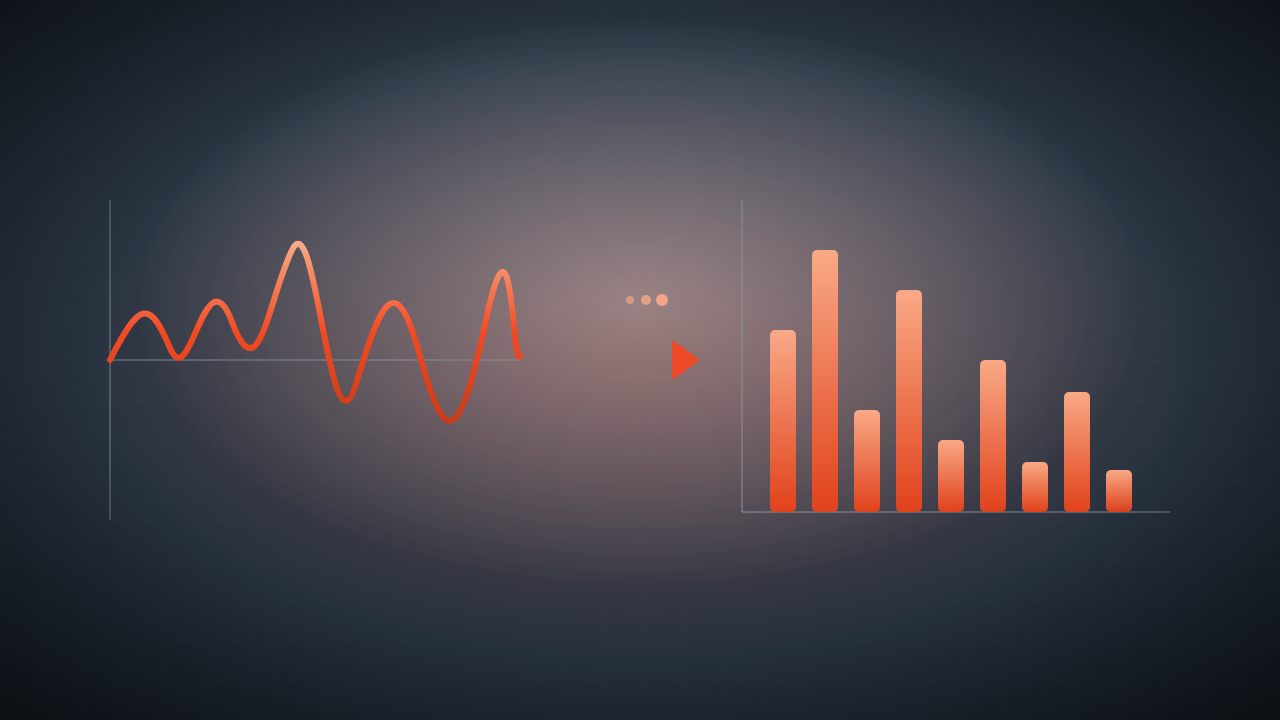
Free Signal Processing 101 cover
What you'll leave knowing

Outcomes for this primer.

Short, interactive and self-paced. Every idea is shown with a live instrument, then checked in the exam.

Turn a raw waveform into a trustworthy spectrum, step by step.

Avoid the traps — aliasing, spectral leakage and the Nyquist limit.

Set sample rate, lines of resolution, windowing and averaging with intent.

See how envelope demodulation reveals a bearing fault weeks early.

The curriculum

16 lessons, in order.

Each lesson is one focused screen — a concept, an interactive graphic, and a plain-language read. Climb the chain, then sit the exam.
01
A quick re-anchor · waveform, spectrum, amplitude, frequency, peak
Time waveform vs spectrum — reading amplitude at each frequency: the Fourier transform (FFT).
02
Step 1 · one sample
A sample is one measured value — a single dot on the curve.
03
Step 2 · sampling
Sampling a sine — the sample rate is your frames-per-second.
04
Step 3 · the limit
Nyquist: you need more than two samples per cycle.
05
Step 4 · the illusion
Aliasing, first seen: the wagon-wheel effect on video.
06
Step 4 · the same trick on a tone
The same fold on a sampled sine: a high tone wears a low disguise.
07
Step 5 · the cure
The anti-alias filter: block high tones before they can fold.
08
Step 5 · why 2.56×
Why analyzers sample at 2.56× Fmax, not exactly 2×.
09
Step 6 · the smear
Spectral leakage: the FFT assumes your block repeats forever.
10
Step 6 · the fix
Windowing: taper the ends so the peak stops leaking (Hanning).
11
Step 7 · lines of resolution
Frequency resolution: Δf = Fmax ÷ LOR = fs ÷ N.
12
Step 8 · no free lunch
The trade: N = 2.56×LOR, and time record T = N ÷ fs.
13
Step 9 · averaging
Averaging: lift a buried tone as the noise floor drops by √N.
14
Step 10 · dynamic range
Dynamic range: turning bits into the decibel scale (≈ 6 dB per bit).
15
The payoff · a taster
Envelope demodulation: reveal the bearing's hidden tap, weeks early.
16
The whole pipeline
From shake to answer — every processing stage in order.
Finish all 16 lessons and pass the 25-question exam to earn your completion certificate — issued on the spot.
Where it fits

Part of the Vibration Foundations badge.

Vibration Foundations badge
Badge 01 of 03

Vibration Foundations

1Vibration FoundationsYou are here

No prerequisite — open to everyone.

See how badges work

A primer — not ISO 18436 certification

TIERA 101 gives you working fundamentals. It is not equivalent to, nor a substitute for, ISO 18436 Category I–IV vibration-analyst certification.

TIERA's formal ISO 18436 Category I–IV programme is separate and paid. Ask us about the certified track when you're ready to go pro.