
Track 01 · Vibration Foundations

Accelerometer & DAQ Selection 101

Good data, or no diagnosis — choose the transducer and the DAQ right.

34 lessons Self-paced 25-question exam Badge: Vibration Foundations

Free · self-paced · your pass is saved on this device.
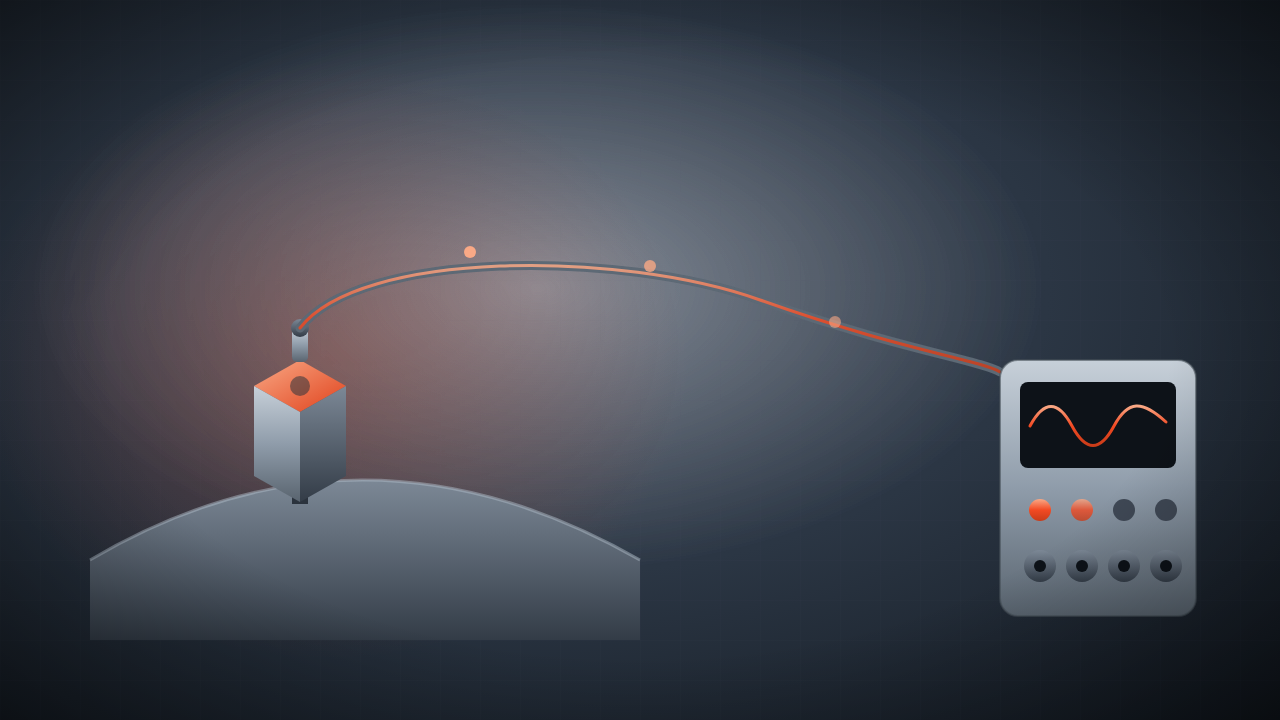
Free Accelerometer & DAQ Selection 101 cover
What you'll leave knowing

Outcomes for this primer.

Short, interactive and self-paced. Every idea is shown with a live instrument, then checked in the exam.

Walk the full measurement chain — transducer → cable → conditioner → DAQ.

Pick the right accelerometer type and read the datasheet numbers that matter.

Understand how mounting sets the highest frequency you can trust.

Avoid ground loops, inter-channel skew and calibration drift.

The curriculum

34 lessons, in order.

Each lesson is one focused screen — a concept, an interactive graphic, and a plain-language read. Climb the chain, then sit the exam.
01
Reading the graphs
Time on top, FFT below — reading order and the noise floor.
02
The measurement chain
Five links: transducer → cable → conditioner → DAQ → software.
03
Inside the sensor
An accelerometer is a mass on a crystal that feels acceleration.
04
Which motion, which sensor
Displacement, velocity, acceleration — three views of one shake.
05
The first datasheet number
Sensitivity (mV/g): loud and sensitive, but easier to overload.
06
Accelerometer type 1 of 5
IEPE / ICP — the everyday sensor with electronics built in.
07
Accelerometer type 2 of 5
Charge-mode — the raw crystal for very hot places.
08
Accelerometer type 3 of 5
Piezoresistive — measures down to DC and steady g.
09
Accelerometer type 4 of 5
Capacitive / MEMS — tiny, cheap, embeddable, also DC-capable.
10
Accelerometer type 5 of 5
Loop-powered 4–20 mA transmitter — install-and-forget protection.
11
Beyond acceleration · 1 of 5
Tachometer / phase reference — the once-per-rev heartbeat.
12
Beyond acceleration · 2 of 5
Proximity / eddy-current probe — watching the shaft itself.
13
Beyond acceleration · 3 of 5
Force sensor & impact hammer — the controlled tap for modal work.
14
Beyond acceleration · 4 of 5
Impedance head — force and acceleration at the very same point.
15
Beyond acceleration · 5 of 5
Shaker / modal exciter — dialling in a known input.
16
Datasheet parameter · the big one
Frequency response, the −3 dB point, and mounted resonance.
17
The error hiding in plain sight
Mounting sets the wall — a magnet can erase your fault.
18
Datasheet parameter
Dynamic range — seeing a whisper next to a shout.
19
Datasheet parameter
Noise floor (µg/√Hz) — the sensor's own hiss sets the smallest fault.
20
Datasheet parameter
Transverse sensitivity — cross-axis leakage between directions.
21
Datasheet parameter
Amplitude linearity — does output stay proportional to input?
22
Datasheet parameter
Phase response — timing must survive the sensor too.
23
Datasheet parameter
Temperature range & coefficient — heat shifts the numbers.
24
Datasheet parameter
Settling time & bias — why IEPE needs a few seconds.
25
Datasheet parameter
IEPE excitation — the constant current that powers the sensor.
26
Datasheet parameter
Grounding & case isolation — killing the ground loop.
27
Datasheet parameter
TEDS — the sensor that introduces itself.
28
Error mechanism · the DAQ
Sample rate, Nyquist & aliasing — fast enough, or a false peak.
29
Error mechanism · the DAQ
Inter-channel skew — why multiplexed DAQs lie about phase.
30
The conditioning half
Signal conditioners — the constant-current source in the middle.
31
Read the real datasheet
The PhonoVibe DAQ family — D, Q, O and HD.
32
Trust the numbers
Calibration — verify the sensitivity is still true.
33
Put it together
Choose the transducer + mount + conditioning + DAQ for THIS job.
34
Recap
Everything you need to choose well, in one place.
Finish all 34 lessons and pass the 25-question exam to earn your completion certificate — issued on the spot.
Where it fits

Part of the Vibration Foundations badge.

Vibration Foundations badge
Badge 01 of 03

Vibration Foundations

1Vibration FoundationsYou are here

No prerequisite — open to everyone.

See how badges work

A primer — not ISO 18436 certification

TIERA 101 gives you working fundamentals. It is not equivalent to, nor a substitute for, ISO 18436 Category I–IV vibration-analyst certification.

TIERA's formal ISO 18436 Category I–IV programme is separate and paid. Ask us about the certified track when you're ready to go pro.